Why projects built with AI all look the same
By Ferhat ZibaAI3 min read
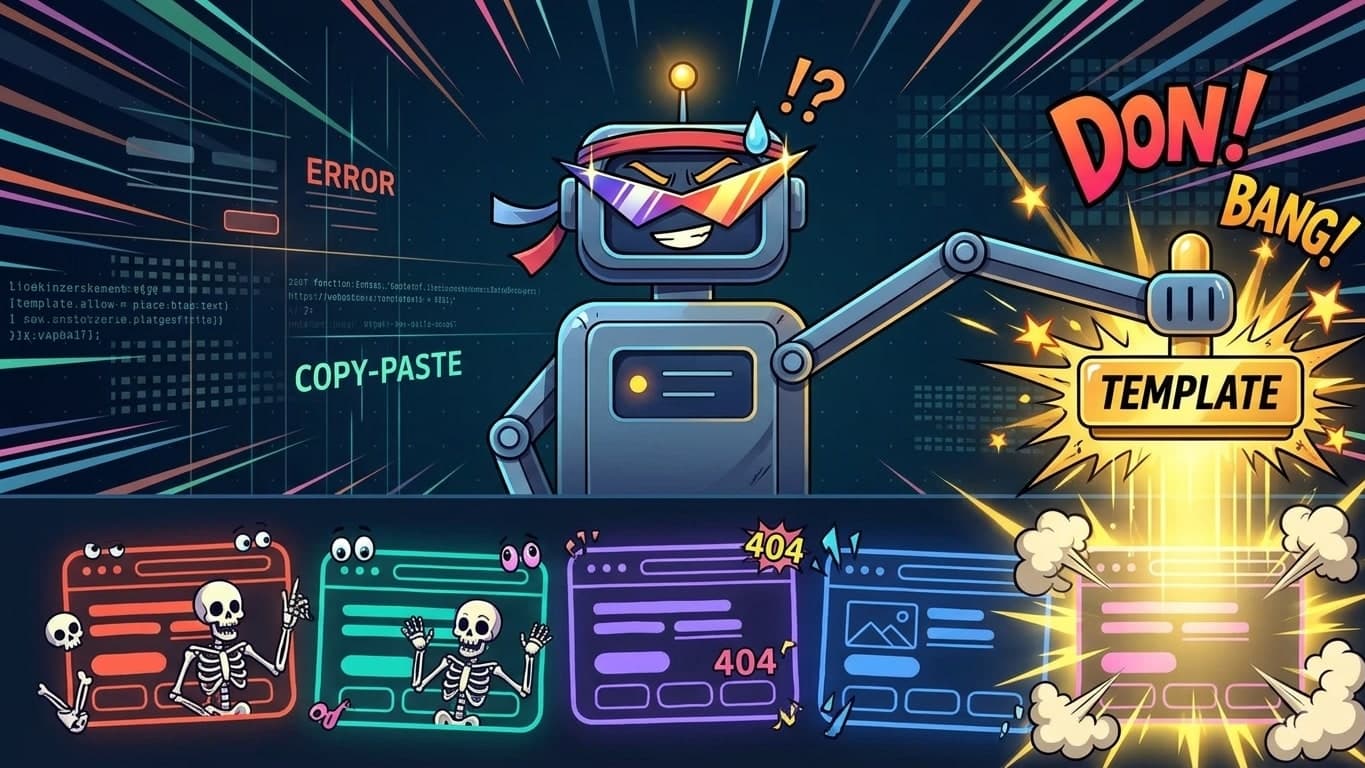
How do you plan a company in the age of AI that stays relevant? I thought about this question for a long time. And I kept noticing the same thing: many new projects look the same. They deliver no real added value, and both in content and in looks they are what is now called "slop": quickly generated mass-produced goods that nobody would miss.
That is no coincidence. It comes from the way the technology behind ChatGPT, Claude and the like arrives at its results.
The AI guesses the next word
A language model, a Large Language Model or LLM for short, does not understand your task the way a human understands it. It calculates which piece of a word is most likely to come next, appends it and calculates again. These word pieces are called tokens. Basically it is the word prediction on your phone, only much bigger and much better.
Something important follows from this: the answer is not freely invented, it is the most probable continuation of your input. And what is probable is the same for everyone. Whoever asks the same question will very likely get the same kind of answer.
Different words, same result
You might think the problem is solved as soon as you phrase your instruction to the AI, the so-called prompt, differently from everyone else. Unfortunately not.
Two prompts can use completely different terms and still deliver almost the same result. Whether you write "Create a modern website for my café" or "Build a stylish homepage for my coffee bar": for the model, both sit in the same place. The meaning is the same, so the most probable continuation is the same too.
Think of it as a map. Two people start in neighboring streets and both always follow the widest road. They arrive at the same square.
How to spot it
If you use AI as a shortcut to produce content quickly and in large quantities, you therefore end up right here very quickly: everything looks similar.
With websites you can now spot it at first glance:
- boxes with rounded corners
- a gradient in the background
- headings where the last part is set in italics or underlined
This is not because these things are particularly beautiful. The task is "website", and in everything the model has learned about websites, exactly these features occur most often. So they are the most probable answer. For you, for your competitors and for everyone else too.
The AI then works like a stamp. The color changes, the motif stays.
The difference is you
So how do you get better results? The answer is simple: the difference is you.
The only thing the AI has not already received from everyone else is what you bring. Your experience, your idea, your text, your taste. Three rules follow from this:
- Your input is the foundation. Write the first draft yourself, even if it is rough. Sketch how something should look before you ask the AI.
- The AI corrects and researches. Let it find mistakes, smooth out wording and gather information. It is excellent at that.
- You decide. Specify what it should do and how. Do not leave the analysis to it, and not the judgment of what is good.
Because the AI is not creative, and it does not know what is good. It only knows what is frequent. That is not the same thing.
Knowing when it is enough
An AI never stops on its own. It always delivers one more paragraph, one more variant, one more suggestion. But real creativity only shows where someone knows when it is enough.
And that is my cue.